Abacus & mental maths
Online abacus classes — from the first bead to doing it in their head
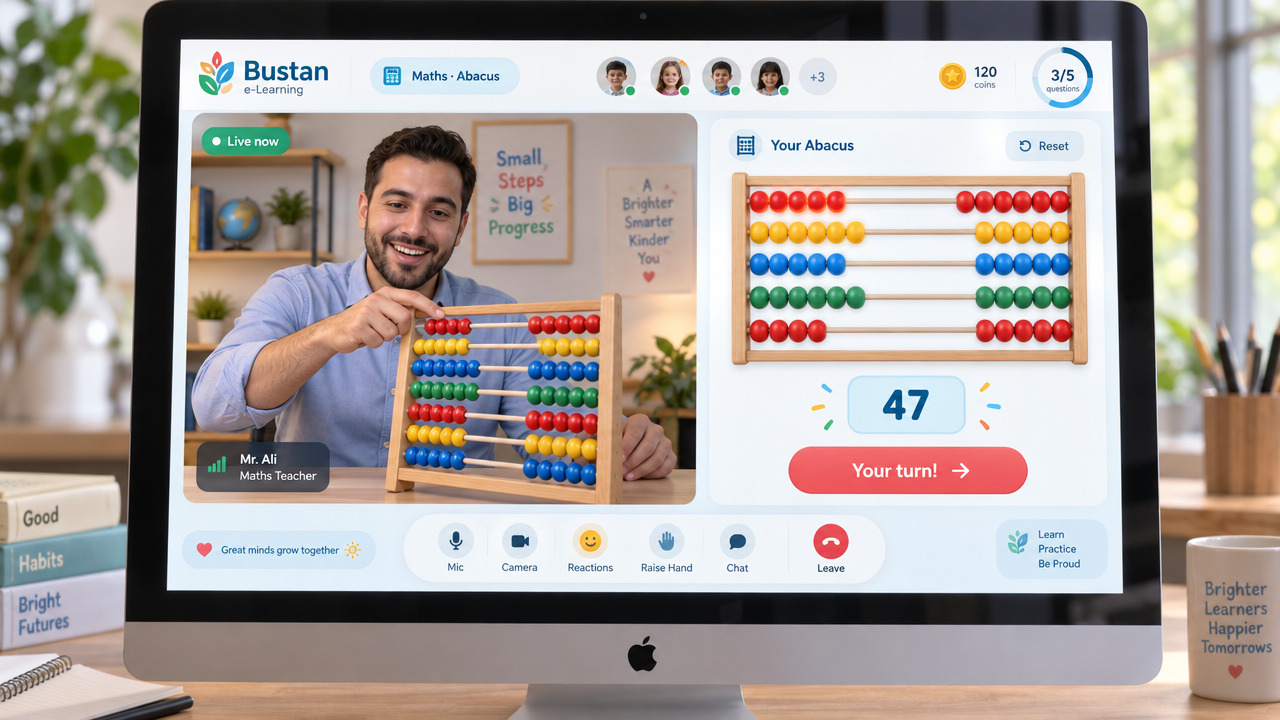
Soroban abacus taught live, in batches of two to four, with the child’s own abacus beside the teacher’s on screen. Children who stay with it add and subtract four-digit numbers without a tool in front of them — and the concentration it takes to get there turns up in every other subject.
What it is actually training
Speed is the visible part. The part that matters more is attention: an abacus row cannot be half-done, and it cannot be guessed. A child either held the number in their head for the whole row or they did not, and they find out immediately which it was.
So when a child gets a row wrong four times, the teaching point stops being arithmetic. It becomes staying with something past the moment it got unpleasant, and checking the work before calling it finished. That is not a bonus of learning abacus; for us it is half the reason to teach it.
In order
The stages
-
Meeting the abacus
Reading a number off the beads, and setting a number onto them. Nothing is calculated yet.
-
One to four, then five to nine
The earth beads, then the heaven bead, and the difference between showing six and showing four.
-
Tens, hundreds and place value
More rods, and the idea that the same bead means something different depending which rod it is on.
-
Straight addition and subtraction
Sums that need no exchange, until the movements are automatic.
-
Small friends, big friends, both
The complement rules — the part where abacus becomes properly fast, and the part where a child has to persist.
-
Without the abacus
Picturing the beads and moving them in the head. This is the point of all of it.
Every subject, same promises
What a class is like, whichever subject it is
Two to four children
Small enough that nobody waits their turn to be noticed, and that a teacher can slow down for one child without holding back another. One to one where that is right.
Taught in English
With Malayalam, Arabic, Hindi or Urdu where a child is more comfortable. You can speak to us in any of them.
The same teacher each week
Who remembers what your child found hard last time, which is the entire point of a small batch.
Around your week
Class times built around school, work and your time zone — wherever in the world that is.
You are told what happened
A note on what was covered, periodic written reviews, and the recording if a class was missed. Built from what the platform recorded, not from memory.
The trial is free
And registering commits you to nothing. We agree the fee with you after the trial, once we know the subject, the batch and how often.
Before you book
Questions parents ask about this subject
Does my child need to buy an abacus?
A physical soroban helps and they are inexpensive, but the lessons include an on-screen abacus, so a child can start without buying anything. We will tell you on the trial call what we recommend for their stage.
What age is abacus for?
Most children start between five and eight. Starting later is fine — the stages are the same and an older child moves through the early ones faster.
Will it help with school maths?
It helps with mental arithmetic, number sense and concentration, and those help with school maths. It is not a substitute for the school syllabus — that is a separate subject, academic tuition, and plenty of children take both.
Is this the same as Vedic maths?
No. Abacus works by picturing beads; Vedic maths is a set of calculation shortcuts. We teach abacus. If you were looking for Vedic maths specifically, say so and we will tell you honestly whether we are the right fit.
Are there competitions or grades?
There are stage levels within our own course and we report your child's stage to you. We do not award an externally recognised qualification, and we would rather say so than imply otherwise.
One free trial class tells you more than this page can
We will call to arrange it, assess your child, and agree a time that fits your week.