Islamic & Moral Studies
Islamic and moral studies — character, not a list of rules
Belief, adab, the life of the Prophet ﻢ, and the character to live by it — worked through situations a child actually meets rather than rules recited back. The sibling, the classmate, the thing nobody saw them do. Taught in English, in batches of two to four, where every child has to answer out loud.
A lesson that runs on questions
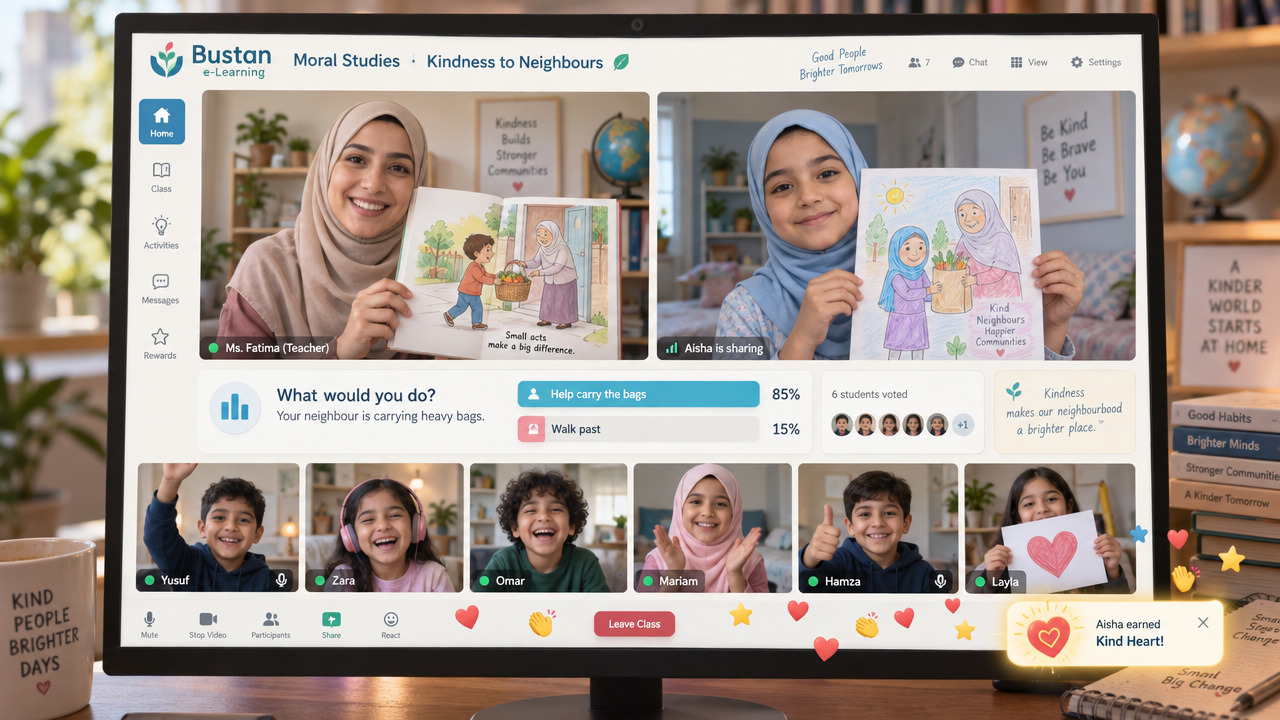
A child can pass a test on honesty and still lie. So this subject is not assessed by whether they can repeat the rule; it is taught by putting them in the situation and asking them to decide, out loud, with reasons, in front of other children.
A story, a dilemma with no supervising adult in it, a class poll, the children's own drawings held up to the camera. The teacher does not close it by stating the rule — she closes it by asking who would know anyway. That only works in a group small enough for every child to speak, which is the second reason the batches are two to four.
In order
What is covered
-
Knowing the Creator
Tawḥīd taught so that a child arrives at it by looking rather than by being told and repeating it back — the order in a leaf, a lung, a number system, an orbit.
-
The Prophet ﻢ, as a person to learn from
The Seerah told as a life rather than a timeline: what he did, in situations a child can recognise, and what that asks of them.
-
Adab, in the ordinary week
Speech, truthfulness, keeping a promise, how you treat the person who cannot do anything for you. Practised rather than listed.
-
Worship, understood
Ṣalāh, duʿāʾ and the adhkār, with the meaning of what is being said, so a child knows what they are doing and why.
-
Growing up Muslim in a country that is not
The questions a classmate actually asks, and how to answer them in that classmate's language without being defensive or apologetic.
-
Work, and being of use
Finishing what you start, carrying your share, being someone your neighbours are glad to have nearby. Assessed as seriously as anything else here.
Every subject, same promises
What a class is like, whichever subject it is
Two to four children
Small enough that nobody waits their turn to be noticed, and that a teacher can slow down for one child without holding back another. One to one where that is right.
Taught in English
With Malayalam, Arabic, Hindi or Urdu where a child is more comfortable. You can speak to us in any of them.
The same teacher each week
Who remembers what your child found hard last time, which is the entire point of a small batch.
Around your week
Class times built around school, work and your time zone — wherever in the world that is.
You are told what happened
A note on what was covered, periodic written reviews, and the recording if a class was missed. Built from what the platform recorded, not from memory.
The trial is free
And registering commits you to nothing. We agree the fee with you after the trial, once we know the subject, the batch and how often.
Before you book
Questions parents ask about this subject
Which school of fiqh do you teach?
Where scholars differ we teach the agreed basics and say plainly that there is more than one position, rather than presenting one madhhab's ruling as the only one. If your family follows a particular school and you would like that reflected, tell us at registration.
Is this just religious instruction with a different name?
It covers belief, Seerah and adab, so yes, it is religious instruction. The reason it is called moral studies is the method: the children argue a case and give reasons rather than memorising and reciting. Several of our parents say this is the subject their child talks about at dinner.
My child was born abroad and asks difficult questions. Will a teacher handle that?
That is much of what this subject is for, and our teachers are used to it. A question is treated as a good sign, not a problem to be shut down.
Do you teach anything about other faiths?
We teach children to understand what their classmates believe well enough to talk to them about it respectfully. We do not caricature anybody.
One free trial class tells you more than this page can
We will call to arrange it, assess your child, and agree a time that fits your week.