
Arabic
Online Arabic classes for children — reading, writing and understanding
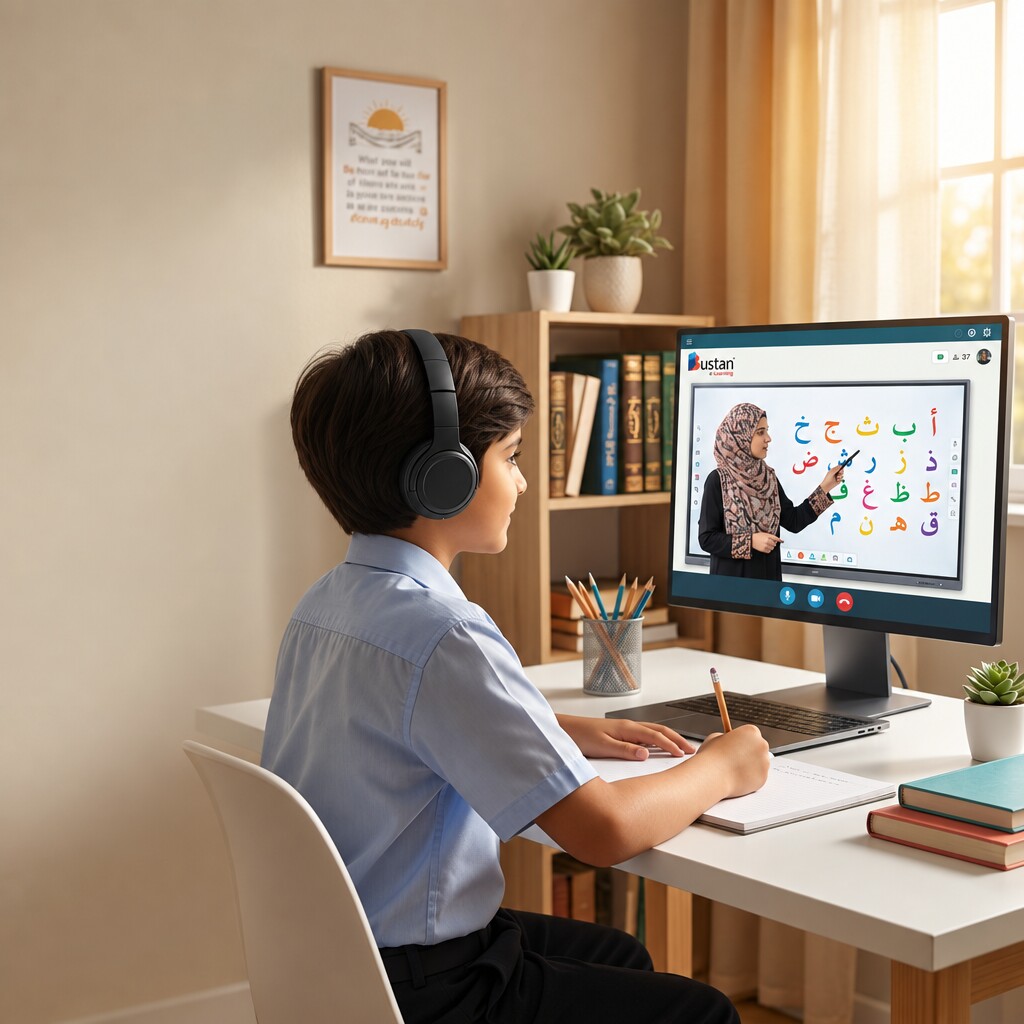
Arabic taught as a language with meaning attached, not a set of shapes to decode. Letters, the vowel marks, the way letters change shape as they join, handwriting, real words, and then reading without stopping. Live, in batches of two to four, explained in English.
Where most children stall, and what we do about it
Decoding without comprehension is where most children give up on Arabic. They can sound out a word and have no idea what it means, so nothing accumulates and the whole thing feels pointless. Our answer is to attach meaning from the first word, and to make each step small enough that no single one is hard.
The lessons are interactive sheets rather than a slide read aloud: a child colours the letter in, writes it by hand, then hunts for it, pops it and catches it until spotting it is instant. And the letter changes as they go, because recognising ب is not the same as knowing the alphabet. You can open any of these yourself from the sample lessons on our home page.
In order
The order it is taught in
-
One letter at a time, in all its forms
Each letter coloured, traced by hand, then found at speed. Then its initial, medial and final forms, because a letter looks different depending on where it sits in a word.
-
The letters that differ only by dots
ب ت ث, and the other families that share one shape. These are the confusions that cause trouble for years if they are left to settle, so they are taught deliberately rather than by accident.
-
Ḥarakāt, and the long vowels
Fatḥah, kasrah, ḍammah, then sukūn, shaddah and the madd letters — how a mark changes what a letter sounds like.
-
Joining, and the shape of a word
Watching each letter change form as a word joins up, which is the step that turns letters into reading.
-
Real words, then reading at pace
Words a child can actually decode, then sight words, then reading a line without stopping. Handwriting runs alongside all of it.
-
Understanding and composing
Vocabulary, phrasing, answering in Arabic, and writing their own sentences.
Every subject, same promises
What a class is like, whichever subject it is
Two to four children
Small enough that nobody waits their turn to be noticed, and that a teacher can slow down for one child without holding back another. One to one where that is right.
Taught in English
With Malayalam, Arabic, Hindi or Urdu where a child is more comfortable. You can speak to us in any of them.
The same teacher each week
Who remembers what your child found hard last time, which is the entire point of a small batch.
Around your week
Class times built around school, work and your time zone — wherever in the world that is.
You are told what happened
A note on what was covered, periodic written reviews, and the recording if a class was missed. Built from what the platform recorded, not from memory.
The trial is free
And registering commits you to nothing. We agree the fee with you after the trial, once we know the subject, the batch and how often.
Before you book
Questions parents ask about this subject
Is this the same as the Qur'an class?
No, and we do not treat them as the same skill. Reading Arabic and reading the Qur'an overlap but are taught separately, because Qur'anic recitation needs Tajwid and Arabic as a language needs vocabulary and composition. Many children take both; plenty take only one. See Qur'an & Tajwid.
What age can a child start?
From about four for the letters, with sheets written for ages 5–8 as well as for older children. There is no upper limit — we teach teenagers who are starting from the alphabet, and the material for them is pitched at their age rather than at a six-year-old's.
Will my child learn to speak Arabic, or only to read it?
Both are taught, but be realistic with us about which matters to you. Reading and understanding come first because that is what the Qur'an and schoolwork need; conversational fluency needs more classes a week and practice outside them, and we will tell you plainly what that would take.
Does my child need an Arabic keyboard or a special device?
No. The lessons run in any modern browser and nothing essential depends on the device having Arabic language support — many of our families' laptops do not have it, so the activities are built to work without it.
My child was taught Arabic badly somewhere else. Can you fix the pronunciation?
Usually, and the trial class is where we find out how much there is to undo. It is easier at seven than at fourteen, but it is not hopeless at fourteen.
One free trial class tells you more than this page can
We will call to arrange it, assess your child, and agree a time that fits your week.